Stream crossings go wrong because of small judgment errors made before anyone gets wet. Here are the mistakes day hikers and newer backpackers make most often, and what to do instead.
Most creek crossings go fine. The ones that turn into emergencies trace back to judgment calls made before anyone got wet: a stream that looked calm, a shortcut around scouting, boots stuffed in the pack. Here are the mistakes we see most often, and what to do instead.
Trusting Calm-Looking Water
Water has force even where the surface looks slow and glassy, so treat every ford as a decision. Toss a decent-sized stick into the current and track it: if it outruns a walking pace, the flow is probably too strong. Probe depth with a trekking pole, keep the water below your knees, and stay out of anything fast and deeper than mid-thigh.
Read the surface too. Lots of small ripples usually point to a shallow, rocky bed; tall waves that hold their shape hint at boulders underneath. Gravel gives the surest footing, while mud and sand can suck your footwear down.
Skipping the Scout
Crossing right where the trail meets the water is the wrong instinct. Walk the banks in both directions first. Standing waves usually mean fast water pushing over boulders or logs, and the sound of rocks rolling along the bottom means serious current. Never step in above rapids, drops or logjams, because a slip will sweep you into them.
The safest spots are straight stretches between bends, the widest parts of the channel, or spots where the flow splits into braids around gravel bars. The outside of a bend is deeper and quicker, with banks carved out from beneath, so a fall there is harder to climb out of than one at a shallow point bar. Pick your exit on the far bank first, since the current will push you downstream as you cross.
Camp tip
If a crossing exceeds your skill or comfort, turn around and find a bridge or another route.
Crossing in Bare Feet
Never wade barefoot. Bare skin slips on wet rock and leaves your feet open to whatever hides under the surface: hidden boulders, sunken logs, snagged fishing line. Open-toed sandals leave your toes exposed to the same hazards, and their drag can throw off your balance.
The fix: bring closed-toe shoes to change into, or if you have none, pull out your socks and footbeds and wade in your boots. Wool socks are worth packing because they insulate even soaked; stash a dry pair in a waterproof bag for the far side. If you are filtering water at camp that evening, our guide to making stream and lake water safe to drink covers the rest of the job.
Facing the Wrong Way
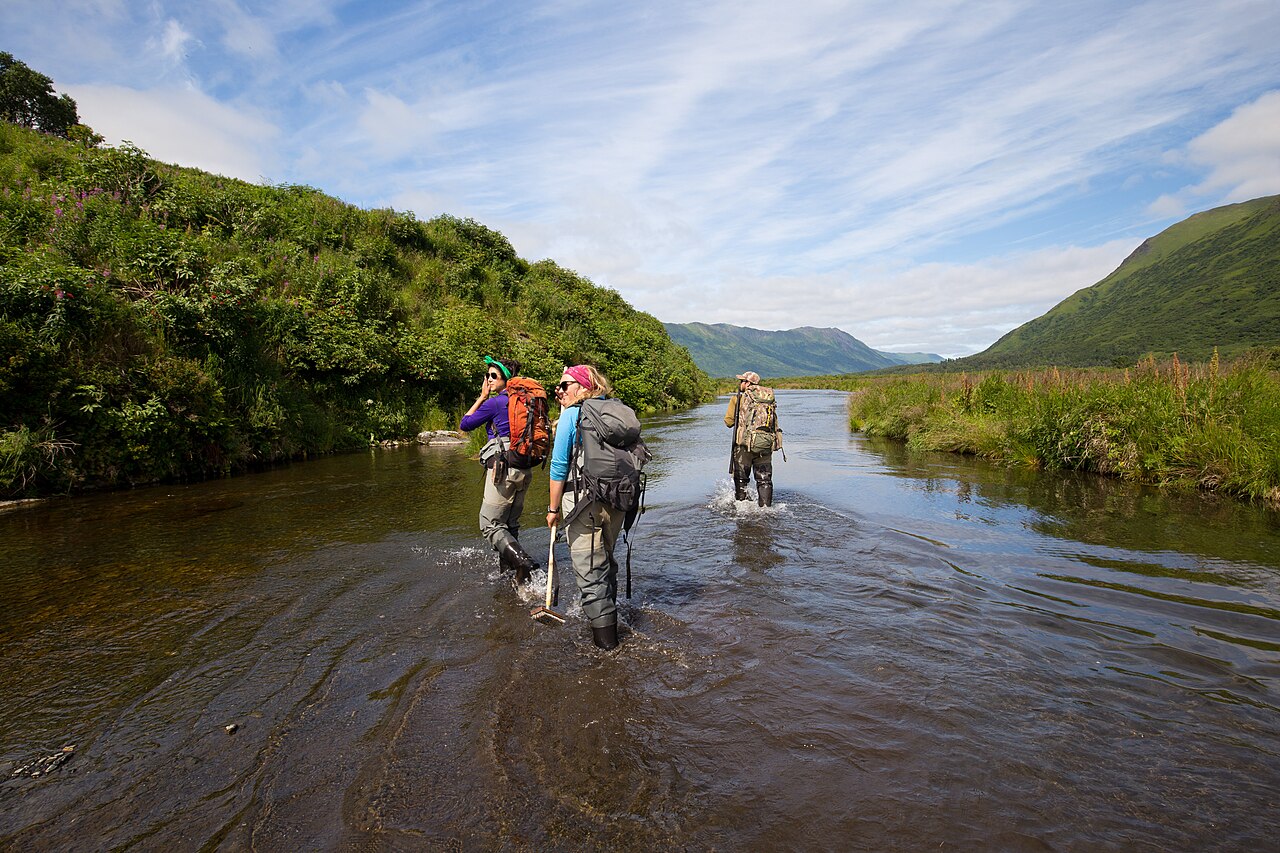
Face upstream as you cross, moving diagonally toward the far bank, with your eyes on the exit rather than the water at your feet. That vantage shows you where the faster channels run.
Solo, hold a pole or sturdy stick on your upstream side to build a steady tripod of two feet and the pole, and shift only one point of contact per step. Without a pole, every lifted foot gives the current a chance to knock you over. The pole doubles as a probe: heavy resistance against it means your legs will feel even more.
Crossing With a Full Pack
A buckled pack can pin you underwater in a swim, but a fully loosened one can shift and throw off your balance. Unbuckle the hip belt and sternum strap so it comes off fast, and move your communication device, fire starter and emergency blanket into a waterproof bag that stays on your body. Be ready to lose the pack entirely.
Crossing During Snowmelt or After Storms
Timing matters as much as technique. Flows can climb steeply within hours on a warm sunny day or after hard rain, turning a walkable stream into something no one should enter. Glacial and snowmelt creeks run lowest and slowest on cool mornings, before the day’s melting gets going. Muddy water carrying floating debris is a typical sign of high water.
Cross ahead of storms whenever possible. The U.S. Geological Survey’s National Water Information System is a good starting point for flow data, and a ranger can tell you what the water is doing. Our article on thunderstorms, lightning and flash floods at camp covers why rain far upstream can raise water where you stand.
Group Crossings Done Wrong
Sending hikers across one at a time is a common group error. Two or more people should wade together parallel to the flow, with the strongest, heaviest person positioned upstream to break the force on everyone else. Lock arms together, or turn upstream and shuffle sideways across.
Set expectations at the trailhead. Physical ability varies, and a tall hiker can hop rocks that shorter ones cannot reach. Rivers are loud, so agree on simple commands first and keep chatter low so instructions carry.
When Someone Goes In
Learn the signs of hypothermia: shivering, clumsy hands, stumbling, slurred words and confused thinking. Treat it by warming the person’s core and getting them into dry clothes.
Do not enter fast water to make a rescue. If someone falls upstream of a downed tree, the water can drive a swimmer into the branches and hold them there, and few people can fight free. Plan a backup route before your trip for days when the water runs too deep, chilly or fast to ford, and be willing to use it.
- Making Stream and Lake Water Safe to Drink at Camp: How to handle the water you collected once you have crossed.
- Thunderstorms at Camp: Lightning, Flash Floods and Wind: Why storms far upstream change water levels where you are hiking.
Camp notes
- Calm-looking water still has force, so treat every crossing as a decision, not a given.
- Scout up and downstream, pick a straight, wide section, and know your exit point before you commit.
- Never wade barefoot; keep boots on or switch to closed-toe shoes.
- Flows can climb sharply during snowmelt, warm weather or storms, so cross early in the day.
- In groups, cross together parallel to the flow with the strongest hiker upstream and arms locked.
Questions campers ask
How deep is too deep to cross a stream?
Keep the water below your knees, and stay out of anything fast and deeper than mid-thigh. The faster the current, the shallower it must be before a crossing is safe.
How can I tell if a current is too strong?
Drop a stick into the current and watch its speed. If it outruns a walking pace, the crossing is probably unsafe.
Should I take my boots off to cross?
No. Bare skin slips on wet rock and leaves your feet open to hidden boulders, logs and debris. Without spare shoes, pull out your socks and footbeds and wade in your boots.
What time of day is best for a crossing?
Early in the day. Glacial and snowmelt creeks run lowest and slowest on cool mornings, and flows can climb sharply within a few hours on warm days.
Rules, fire restrictions and closures differ by park, forest and district and can change quickly. Check with the land manager before your trip. This guide is general information, not professional safety advice.